
What does an SEO audit cover?
An SEO audit is a structured assessment of a website’s organic search visibility. It combines technical checks with a review of whether the site structure and content match the audience’s search queries.
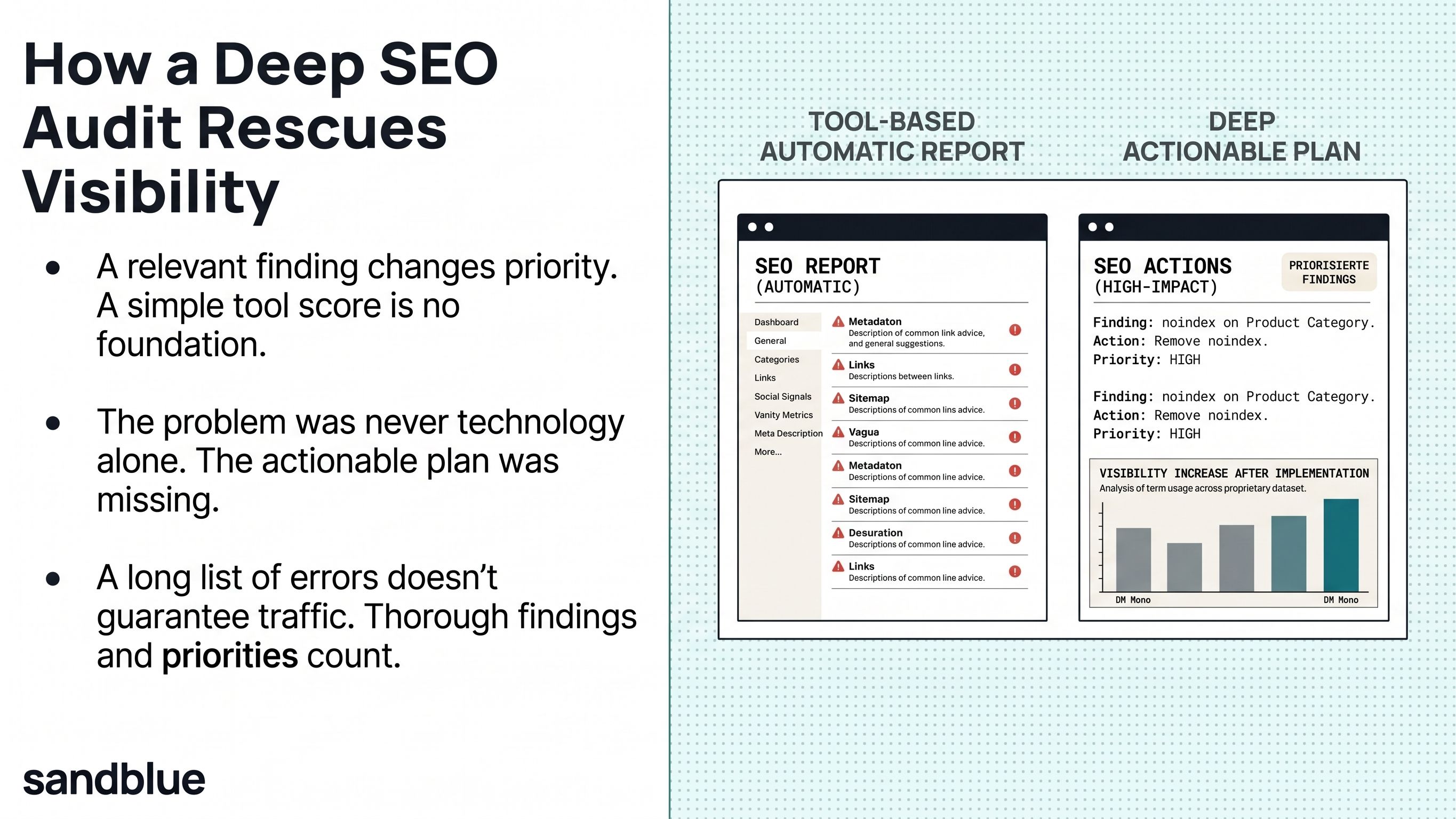
The difference from an automated tool report is interpretation. An error message is initially a clue. It only becomes a useful task once you know which pages are affected, why the finding matters and what should change.
When is an SEO audit worthwhile?
An audit is most useful when a concrete decision is needed but the causes or priorities are unclear. Three common situations:
- After a relaunch: important landing pages lose visitors or can no longer be found.
- When growth stalls: new content is being published, but relevant pages attract little additional organic traffic.
- Before major investment: you want to know whether to improve technology, structure or content first.
A decline alone does not prove a technical fault. Google also identifies seasonal demand, changes to search systems and data issues as possible causes. An investigation therefore starts with affected pages, queries and suitable comparison periods.
Source: Google – debugging drops in search traffic
When is a targeted check enough?
A targeted check is often enough when the problem has already been narrowed down. A single redirect or a clearly identified indexing issue does not automatically require an examination of the entire website.
| Situation | Useful starting point |
|---|---|
| One URL is causing problems | Targeted URL and root-cause check |
| Several important areas lose visibility | Audit focused on the affected page types |
| The actions are already clear | Implementation followed by validation |
What should a good audit deliver?
A good audit provides a clear basis for decisions and actionable tasks. Its scope should fit the website; not every project needs log files or a detailed JavaScript analysis.
- Overview: which findings matter most and which questions remain open?
- Action plan: affected URLs, evidence, recommendation, priority and validation criteria.
- Supporting data: relevant crawl and analysis extracts so findings remain verifiable.
Turning a finding into a task
A useful task connects a verified finding with a specific change and a follow-up check. The following example is illustrative and does not come from a client project.
- Finding: an important category page contains a noindex directive.
- Check: is the exclusion intentional, and can Google detect the directive when crawling?
- Action: if the page should appear in search results, remove the unintended exclusion.
- Validation: inspect the delivered or rendered HTML and use URL Inspection in Search Console.
Google must be able to crawl a page to detect noindex. Removing the directive removes this obstacle but does not guarantee indexing or a particular ranking.
Source: Google – blocking indexing with noindex
How do you set the right priorities?
Priority depends on the importance, reach and feasibility of a finding. A task affecting key product or service pages may matter more than many small warnings on unimportant URLs.
I would ask four questions about each recommendation: which relevant pages does it affect? How well is the cause supported by evidence? What effort and dependencies are involved? How will we know the change was implemented correctly? A generic tool score does not answer these questions.
What happens after the audit?
An audit is followed by decisions about actions, implementation and validation. Without these steps, even a good analysis remains a document.
Assign owners and a realistic timeline to the most important tasks. After implementation, first check technical correctness. Then monitor relevant pages over an appropriate period. A later traffic increase cannot automatically be attributed to a single change.
What should you clarify before commissioning an audit?
- What is included, and which additional analyses cost extra?
- What access and data are required?
- How will results be delivered and discussed with the team?
- Are implementation support and follow-up checks included or available separately?