
What is llms.txt?
Search is moving from finding links towards receiving synthesised answers. For website owners, llms.txt offers a proposed way to guide language models towards important pages. It is a Markdown file placed at the root of a website, usually at /llms.txt.
Think of it as a curated map of documentation, service pages and other useful resources. It aims to reduce navigation clutter and make relevant content easier to access. In theory, this could improve retrieval, citations and referral traffic. In practice, each platform decides whether to use the file. It is not an access-control mechanism like robots.txt.
Our test: mid-October to December 2025
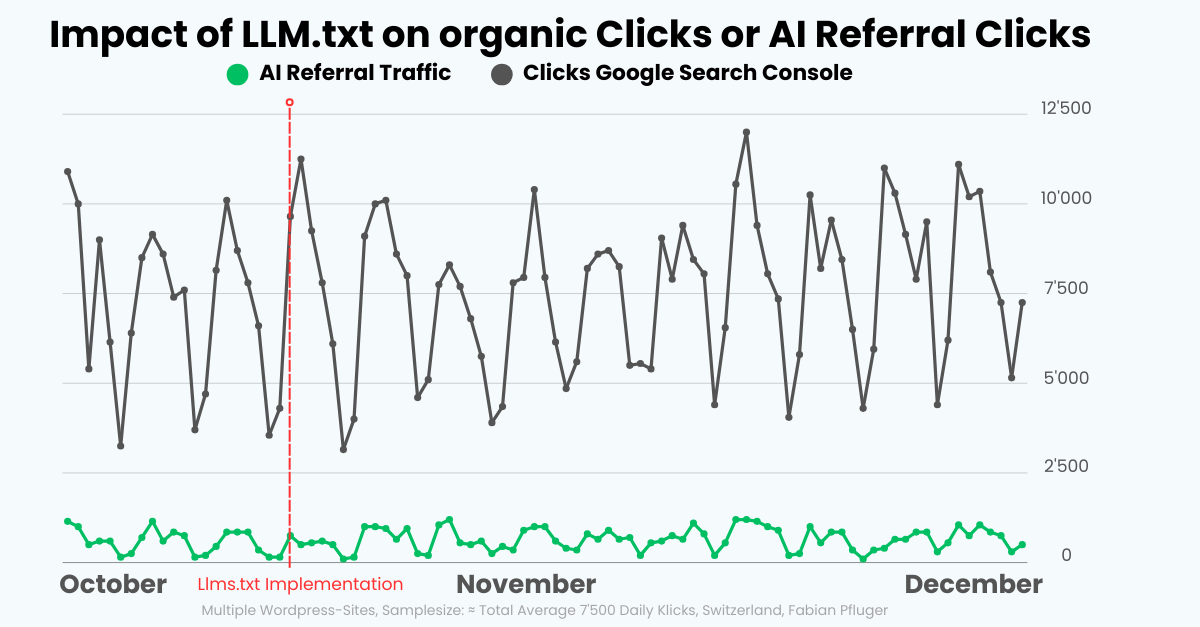
We introduced llms.txt in mid-October across several Swiss WordPress websites. Together, these sites recorded approximately 7,500 daily clicks according to the original analysis. We observed Google Search Console clicks and AI referral traffic through December, then checked server logs for requests to the file.
What changed after implementation?
- Organic clicks showed normal fluctuations, without a clear uplift following implementation.
- Recorded AI referral traffic remained broadly stable in November and December.
- We found no convincing relationship between implementation and additional AI referral traffic.
We did not analyse impressions in the original test. The original article cited reporting changes around the removal of the num=100 parameter in September 2025 as the reason. The test therefore offers no finding about impression trends.
What can this test tell us?
This was an observational test, not a controlled experiment. The original publication does not provide the exact number of websites, raw data, a control group or statistical significance tests. Seasonality, other website changes and search-platform developments cannot be ruled out as influences.
AI referrals measure visits, not every brand mention or citation. Aggregate Google clicks also cannot isolate the effect on AI Overviews or AI Mode. Google includes those features in overall Web search reporting. The useful conclusion is limited: no clear traffic effect was visible in the period studied.
Google Search Central: AI features and your website
Server logs: did bots request the file?
We found no meaningful activity at /llms.txt comparable with requests to robots.txt or sitemap.xml from the agents examined. These included Googlebot Smartphone, Googlebot Desktop, ChatGPT-User, OAI-SearchBot, PerplexityBot and ClaudeBot.
This describes the websites and period observed. Even a request would not by itself prove that the file influenced an answer or citation.
The cats.txt analogy: a file is not automatically a standard
The original article refers to Mark Williams-Cook’s cats.txt analogy: publishing a file is easy; adoption depends on whether relevant systems support it. llms.txt is community-driven, while crawler behaviour remains under platform control. Google says special AI text files are not required to appear in AI Overviews or AI Mode.
Implementation with WordPress
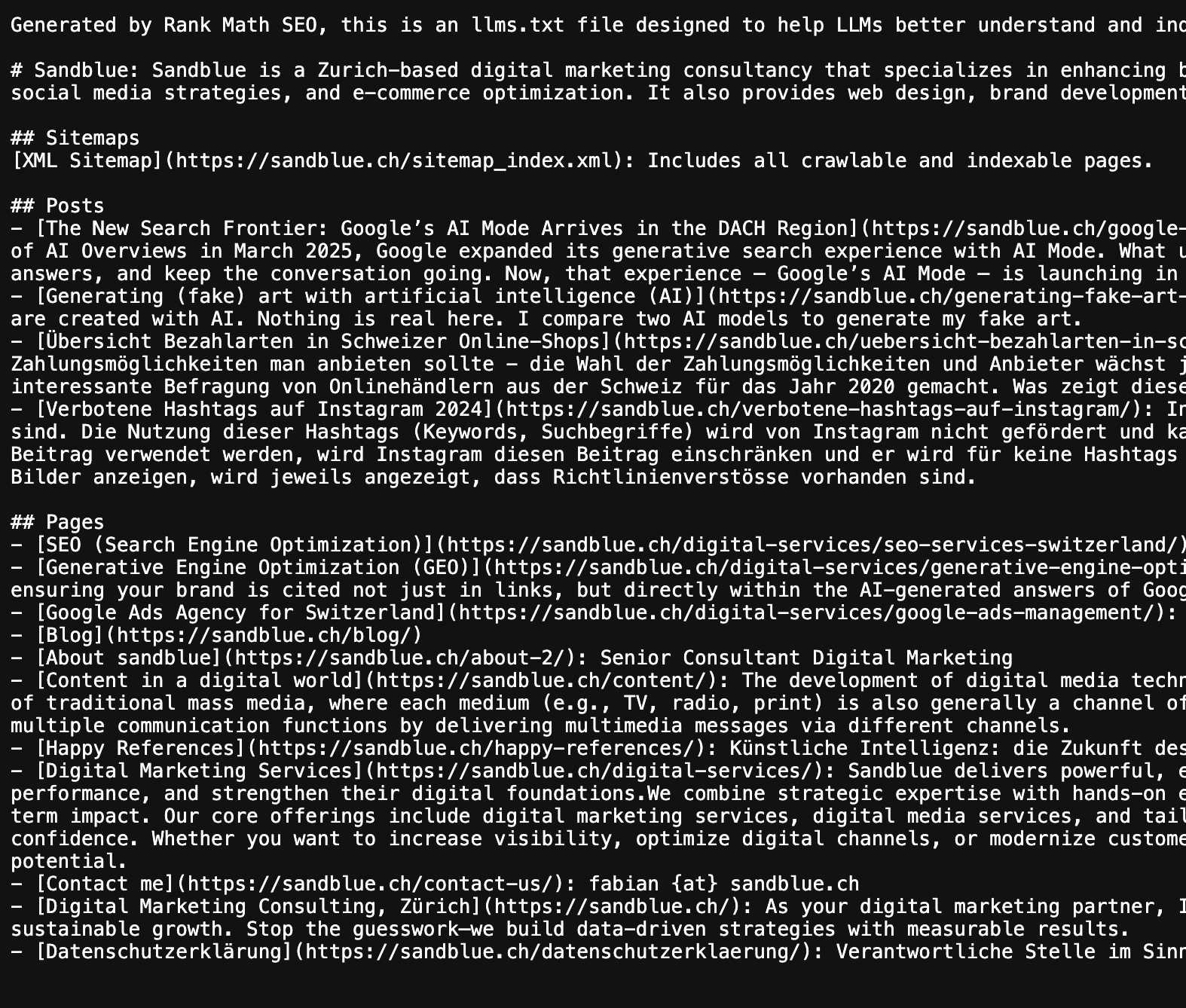
Yoast and Rank Math document llms.txt features. If you enable one, review the generated descriptions and links and keep them current. Other generators are available, but their output still needs to be published and maintained on the website.
Rank Math: configuring llms.txt
Should you invest in llms.txt?
If implementation takes little effort, it can be a limited experiment. Our test does not justify promising additional AI traffic. Where resources are constrained, I would prioritise crawlability, internal links, useful content and credible evidence. Record implementation dates, bot requests and AI referrals if you want to evaluate your own results.